English
Views: 0 Author: Site Editor Publish Time: 2026-11-25 Origin: Site


 HDF vs. MFB vs. MgO Flooring Cores: Which Core Should You Specify for Humid Climates?
If you supply or install flooring in coastal regions, tropical markets, or areas with prolonged rainy seasons, you have likely dealt with the same costly after-sales headaches: edge lifting, plank swelling, and joint bubbling just months after handover.
When callbacks happen, buyers often blame the wear layer or the locking system. In reality, most moisture-related flooring failures start inside the core. While the surface film and wear layer handle daily scratches and aesthetics, the core board dictates dimensional stability, water resistance, and how well the click profile holds together when humidity spikes.
To help distributors, contractors, and project specifiers avoid preventable replacements, this guide breaks down the three mainstream core materials used in modern wood-look and mineral-based plank flooring — HDF (High-Density Fiberboard), MFB (Mineral Fiber Board / Mineral-Filled Composite Core), and MgO (Magnesium Oxide Board). Read on to find out which core fits your next project.
HDF is the traditional backbone of standard laminate flooring, manufactured by compressing wood fibers with synthetic resins under high heat and pressure.
Note: HDF cores come in multiple grades, including standard HDF and moisture-resistant /water-repellent HDF variants.
Cost-Effective: Offers the lowest unit cost among the three options, making it easy to price competitively for high-volume residential orders.
High Impact Resistance: Dense wood fiber construction resists denting from heavy furniture and delivers a familiar, solid underfoot feel.
Easy Machining & Installation: Standard woodworking blades cut HDF cleanly with minimal tool wear, keeping installation speeds high on site.
Moisture Sensitivity: Because HDF is wood-based, exposed edges and unsealed joints will absorb moisture and swell if standing water sits on the floor or subfloor humidity rises. Even “water-resistant” waxed-edge HDF has strict usage limits in wet zones.
Fire Rating: Combustible compared to mineral cores, which can restrict its use for projects following strict commercial building codes.
Dry-climate residential bedrooms, living rooms, and budget-sensitive retail renovations where subfloor moisture is properly controlled.2. MFB Core (Mineral Fiber / Mineral-Filled Core)
MFB bridges the performance gap between traditional wood-based laminate and rigid mineral boards. By blending mineral fillers with specialized binders and fibers, MFB removes the swelling weakness of pure wood cores while retaining good milling properties.
Strong Moisture & Dimensional Stability: Significantly lower thickness swelling than HDF, preventing joint peaking and edge lifting under fluctuating indoor humidity.
Balanced Weight & Workability: Lighter than dense mineral boards and easier to score, snap, or saw than cementitious substrates, cutting installation time and reducing blade wear.
Strong Click-Lock Retention: Holds precision-machined click profiles well, lowering the risk of brittle edge chipping during fitting.
Mid-to-High Price Point: Costs more per square meter than standard HDF, so you will need to communicate its moisture-resistance value clearly to cost-focused buyers.
Formulation Variance: Final performance depends heavily on each factory’s mineral-to-binder ratio; consistent raw material sourcing is critical for reliable quality.
Whole-home installations (including kitchens and entryways), multi-family apartments, and humid subtropical regions where clients want laminate-style visuals without the swelling risks of wood cores.
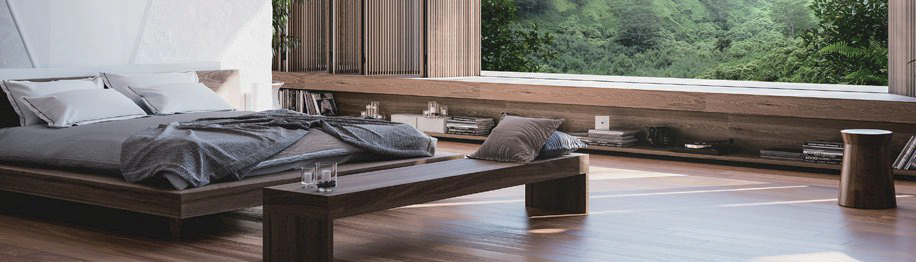
MgO flooring uses an inorganic mineral core composed primarily of magnesium oxide, magnesium chloride or sulfate, and reinforcing fiberglass mesh. Long valued for fire-rated construction, MgO has grown into a popular PVC-free, high-performance flooring substrate.
100% Waterproof & Mold-Resistant: Its inorganic mineral composition will not swell, warp, or support mold growth, even with long-term damp exposure.
A1 Non-Combustible Fire Rating: Withstands extreme heat without burning or releasing toxic smoke, satisfying strict commercial and public-building safety codes.
PVC-Free & Zero Formaldehyde: Contains no wood-based urea-formaldehyde resins and no plasticizers, making it ideal for green building certifications such as LEED and WELL.
Higher Upfront Cost & Weight: Heavier per container than HDF, which pushes up freight cost alongside higher raw material pricing.
Installation Handling: Requires carbide-tipped blades for cutting and rigorous subfloor flatness checks (per ASTM standards). Uneven concrete creates stress on rigid click joints.
Commercial spaces, hospitals, schools, basements, coastal villas, and projects requiring PVC-free materials or A1 fire-rated specifications.
| Specification Factor | HDF Core | MFB Core | MgO Core |
|---|---|---|---|
| Primary Composition | Compressed wood fibers + resin | Mineral fillers + composite binders | Inorganic magnesium oxide + fiberglass mesh |
| Water & Swelling Resistance | Moderate (vulnerable at seams) | High (low swelling rate) | Highest (100% waterproof, zero swelling) |
| Fire Rating | Standard (Combustible) | Improved Flame Retardancy | Class A1 Non-Combustible |
| VOC / Eco Profile | Low-VOC (E1/E0 options) | Low-VOC / Formaldehyde-free options | Zero Formaldehyde & 100% PVC-Free |
| Cutting & Installation | Very easy (standard saws) | Easy to moderate | Moderate (requires carbide blades) |
| Upfront Material Cost | $ (Most economical) | $$ (Mid-range) | $$$ (Premium) |
Before confirming your next container order, match the core specification to real jobsite conditions:
✅ Choose HDF when the project is dry residential and competitive retail pricing is the top priority.
✅ Choose MFB when you want a reliable upgrade over traditional laminate — great humidity protection, simple installation, without the premium price tag of full mineral commercial flooring.
✅ Choose MgO when specs require zero-PVC sustainability, A1 fire safety, or true waterproof performance for commercial buildings, basements, and rainy coastal climates.
At DareKaou Floor, we manufacture Laminate, SPC, and PVC-free MgO flooring solutions directly from our factory to support contractors, wholesalers, and brand partners worldwide. Whether you are testing swell rates for a humid market or comparing pricing tiers for an upcoming tender, our team can send physical core cross-section samples and full test reports.


